
Viva La Revolucion – Chile Drinks Wine
POSTED ON 06/07/2009Tiramisu in smart Las Condes is the place to see and be seen on a Saturday night in Santiago. By nine, the trendy Italian hotspot is heaving with beautiful people washing down pizza and seafood with not quite so beautiful piscola, an unholy alliance of coke and pisco, along with beer, pisco sours, coke, Canada Dry, and the occasional bottle of Montes Cabernet Sauvignon or Casa Silva Carmenère. Under the dim lights of Liguria in trendy Providencia, where the cool set sips to the sound of 1960s Beatles, it’s a similar story as a handful of fashionably attired young people prop up the bar with a glass of wine. Only at the Normandie close by is the hit rate respectable by wine lovers’ standards. With a deferential nod to French culture in the form of a gauloise-and-gun-toting Jean-Paul Belmondo on permanent loop, almost everyone’s knocking back good Chilean wine here, by the glass, carafe and bottle.
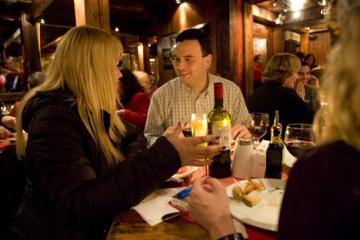 Tiramisu ©Charmaine Grieger
It’s a different picture at Hector Vergara’s El Mundo del Vino, a specialist downtown wine shop where the average bottle price is £9 and the average spend £22. Beyond the traditional consumer who drinks cabernet sauvignon ‘there’s a new type of consumer’, says Hector. ‘They’re mainly professionals under 40 who’ve travelled and read wine articles. They’re starting to enjoy pinot noirs with salmon, swordfish, tuna and sea bass and they also like the fresh, aromatic qualities of cool climate syrah. When we opened the store in 1999 we had a metre of shelf space for carmenère and seven for merlot and now it’s the other way round’. Roughly three-quarters of his sales are red with sauvignon blanc El Mundo’s flagship white, followed by chardonnay, viognier, riesling and white blends. Brut and champagne method sparklers are taking over from demi-sec and charmat. ‘A sign of consumers becoming more sophisticated is that they want more choice and they’re starting to ask for wines by location’, says Vergara.
Growing sophistication among Chile’s wine consumers is a far cry from the days when Hector Vergara’s father ran a grocery store in the sixties and seventies. The main business was wine and as he points out ‘wine was always served at the table but it was red and white, whereas now people are paying far more attention to what they’re serving’. At that time, the locals drank getting on for 60 litres a head and they either bought their wine in 5-litre containers or they would come along and fill up from Vergara senior’s 15-litre chuicas. ‘The red was mostly from Maipo, mainly cabernet, the white was semillon and then there were brands like Santa Teresa, Ochagavia, Peñaflor, often sold by the Basque wineries like Valdivieso, Viu Manent and Canepa’.
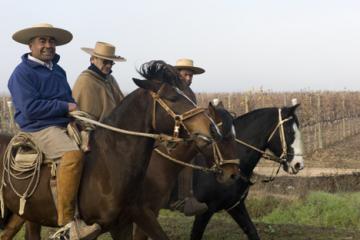 Giddy up © Charmaine Grieger
It’s taken Chileans quite some time to start feeling comfortable in their own skins with their own home-grown product. Despite a 19th century heritage of prestigious names such as Cousiño Macul, Undurraga and Concha y Toro, any pretensions that the majority of Chileans have to a wine culture were based on a tradition of early 20th century bulk sales by Spanish wine merchants, known as the Vicuña McKenna Catalonians, of 15-litre chuicas, 10-litre demijuanas and 5-litre garafas to inns and shops. Chileans became so fond of this basic plonk that as consumption reached 90 litres a head, prohibition was introduced in 1939 outlawing the planting of new vineyards. At a stroke, the vineyard surface fell from 106,000 to 92,000 hectares and then more gradually until by 1994 it stood at a low point of 53,000 hectares (it’s now back up to 117,000).
As consumption declined, wineries such as Concha y Toro, Undurraga, Santa Carolina, Santa Rita and San Pedro, traditionally at one remove from the murky world of commerce, started to sell and distribute their wines. But it was Miguel Torres’s deus ex machina arrival in 1978 that acted as the spur to the subsequent boom of the 1990s and beyond. Soon, the talk was of varietal wines and exports even if at first consumers brought up on oxidised whites found the new style too light and flowery for their old-fangled palates. Exports grew from 36 million bottles in 1990 to 39.5 million cases by 2008, while on the reverse side of the peso, domestic consumption fell sharply from 50 litres in the 1970s right back to 13.1 litres by 1997. Thanks to the past decade’s revival, consumption is back up to 18 litres a head.
A growing enthusiasm for Chilean wine abroad and the ‘discovery’ of carmenère in the mid-1990s encouraged the creation of superior quality wines such as Don Melchor, Montes Alpha, Casa Real, Carmen Gold Reserve, Finis Terrae, Don Maximiano, Seña and Antiyal, while Viñedo Chadwick was eventually fêted in 2004 when it took first place in a comparative blind tasting, Judgment of Paris-style, in Berlin. Chile always had good basic fish and meat and, typically, lots of corn-based foods like humitas and pastel de choclo, but the effects of ‘The Golden Decade’ of the nineties were to kindle a greater appreciation of gastronomy with sommeliers, new boutique wineries and specialist wine shops all capitalising on Chilean’s growing pride and interest in their own wines.
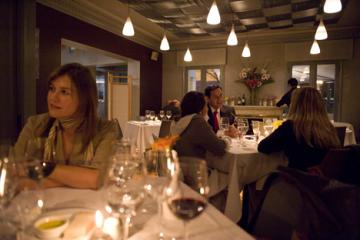 Akarana, Santiago © Charmaine Grieger
A legacy of the old mentality lives on. 80 per cent of the domestic market still consists of sales in tetrapak with Concha y Toro’s Clos de Pirque cabernet, merlot and chardonnay and Fresco at the equivalent of £1 a bottle each selling around one million cases, while the average bottle price is around £2.50. According to Raul Beckdorf, marketing manager at Anakena, ‘it’s still a struggle to get many consumers to trade up because there’s still a feeling “why pay £7.99 if you can buy whisky which will last longer”’. But there are many positive signs that Chilean wine is becoming part of the culture. Chileans are not just trading up to good everyday brands such as Concha y Toro, Undurraga, Santa Rita and Santa Carolina at the £5 - £6 mark. According to Eduardo Matte jnr. at Haras de Pirque, ‘if you went to someone’s house it was traditional to have a piscola, coke or beer, but today’s young people are drinking wine and it’s smart to bring something a bit special like a £10 Haras de Pirque, Pérez Cruz or Marques de Casa Concha’. Now you know what to take to a Santiago dinner party next time you’re invited.

Comments
Anthony,
I am sorry to see you've lost your devilish caricature. Makes em think perhaps the portrait of Santiago is safer than you once might have penned? Anyhow, whilst you were here in Chile, I am sure you felt tremors, and I wanted to explain about the earth moving. With twelve "small" wineries the Movement of Independent Chilean Vintners or, El Movimiento de Viñateros Independientes de Chile has been formed. As I am sure you know, Chile is known for large wineries and industry concentration. Rabobank says we have by far the largest average winery size of any wine-producing nation and that one player comprises more than a third of exports in key markets but I digress...
The Movement, MOVI for short, and we'll be blogging and twittering soon, is made up of a dozen partners [to begin]. Each project is terroir specific and must be both quality and originality driven to be considered. A counsel has been elected with a strict entry only through tasting policy from the get-go. Besides a few already-known faces already on the shelves at Hector's Mundo del Vino, the Movement is comprised of Bio-dynamic gurus, dry-farmers, a count, a lawyer, some die-hard garagistes and a splash of old-worldies without chateau affiliation. You would have to taste the wines of course to feel the earth move under your feet, but we can promise, soon, a breath of fresh-air amidst our prim and sometimes orthodox oligarchical big brothers.
Sorry for the seismic diatribe...
Un Viñatero Independiente
Los Viñateros Independientes de Chile